

The Breakup Recovery Timeline Nobody Gives You

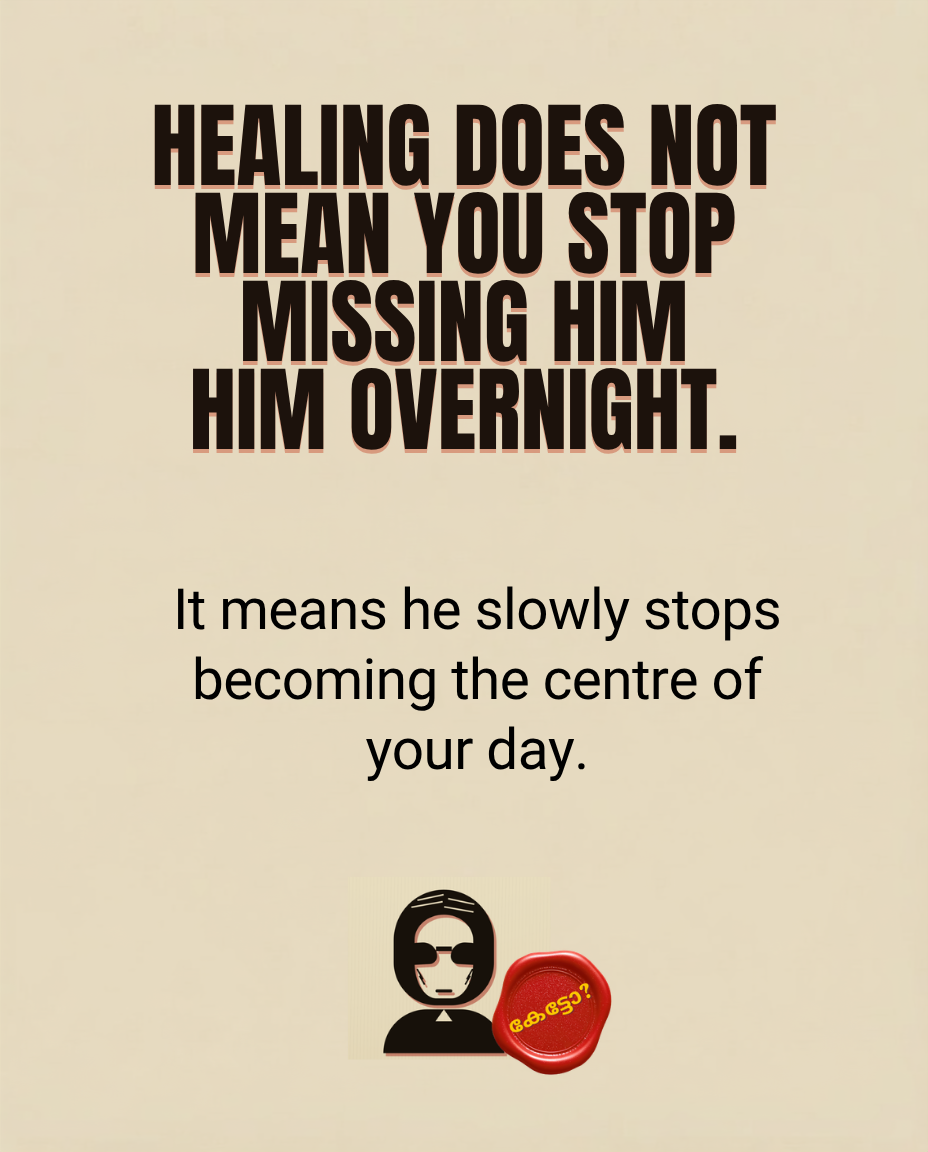
A breakup recovery timeline is not fixed, but most healing moves through stages. The first 72 hours are for stabilising, the first week is for avoiding impulsive contact, the next few weeks are for breaking the routine of him, and the following months are for rebuilding your life. Healing does not mean you stop missing him overnight. It means he slowly stops becoming the centre of your day.
Breakup recovery is not a neat 30-day challenge. Chechi walks you through what the first days, weeks, and months can actually feel like, and how to stop organising your life around him.
A breakup recovery timeline is not a neat 30-day challenge. The first few days are for stabilising, the first few weeks are for surviving the habits, the next few months are for rebuilding your life, and the real healing happens when you stop organising your day around what he did, said, posted, or failed to say.
You may miss him and still be healing. You may feel strong on Monday and useless on Thursday. You may be completely sure you did the right thing and still cry because one song came on in an auto.
Recovery is not about becoming untouched. It is about slowly becoming yours again.
Is there a real breakup recovery timeline?
There is a timeline, but it is not a fixed calendar. It is more like weather.
Some days are clear. Some days look clear and then rain starts at 5 pm because you saw his name somewhere. Some days you feel peaceful in the morning and furious by dinner. This does not mean you are going backwards. It means your heart is processing something that mattered.
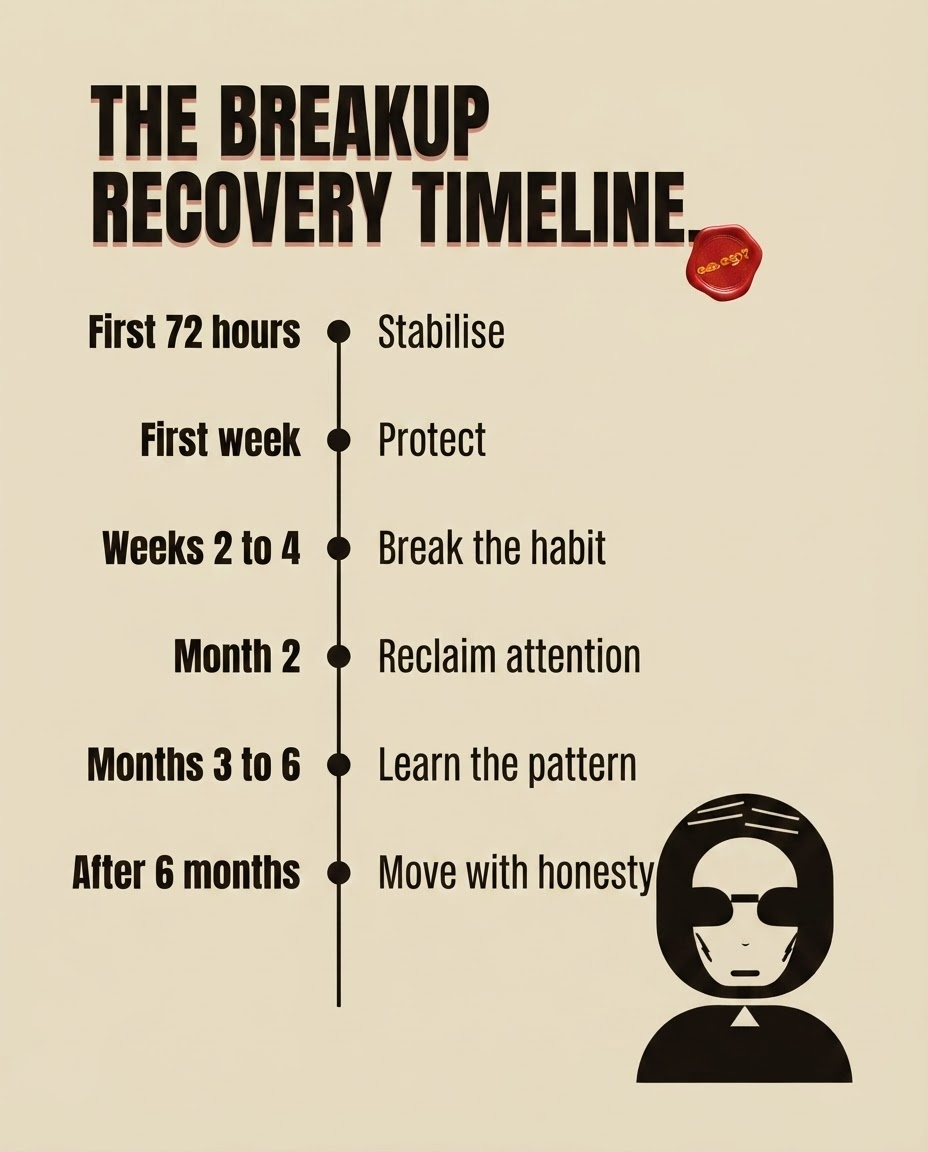
A useful breakup recovery timeline looks at stages, not deadlines:
- The first 72 hours: stabilise your body and stop the immediate damage
- The first week: protect yourself from impulsive contact
- Weeks 2 to 4: break the routine of him
- Months 2 to 3: rebuild your life without checking for his shadow
- Months 3 to 6: notice what you learned and what you will not repeat
- After 6 months: let the story become one part of your life, not the centre of it
Some people move faster. Some take longer. Length does not prove love. Speed does not prove strength. Your healing pace is not a performance review.
The first 72 hours: stop the bleeding
The first 72 hours after a breakup are not for wisdom. They are for food, sleep, water, and not sending the message that will make tomorrow harder.
In the first three days, your mind may run everywhere. You may want to call him, explain again, ask one last question, check if he is online, read old chats, or tell yourself you just need closure. You may also feel numb, relieved, angry, embarrassed, or strangely normal.
Do not judge the feeling. Just reduce the damage.
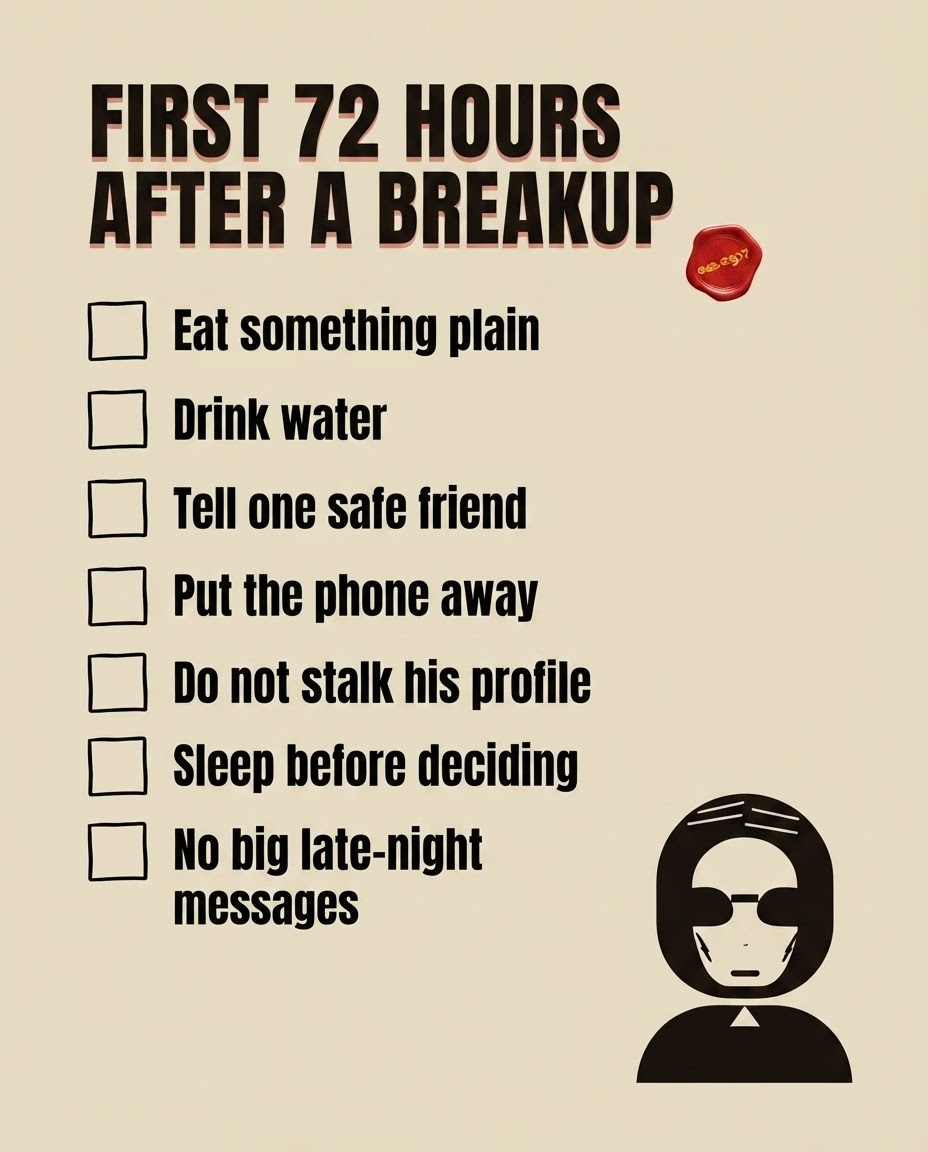
For the first 72 hours:
- Eat something plain and proper
- Drink water even if you are not hungry
- Sleep beside your phone only if it is on airplane mode
- Tell one safe friend what happened
- Do not make big decisions late at night
- Archive or mute the chat if seeing it hurts
- Avoid alcohol if it makes you text
- Do not stalk his profile for “clarity”
This is the stage where you need boring care, not big speeches. Shower. Change your bedsheet. Put your phone away while eating. Let your body understand that the world did not end, even if one version of your future did.
If you feel like you may hurt yourself or you cannot stay safe, contact a trusted person near you or emergency services immediately. That is not the moment to be private or brave. That is the moment to get help.
The first week: protect yourself from the habit of him
The first week is when the relationship routine starts screaming.
Your hand reaches for the phone before your brain catches up. You want to send him something funny. You want to tell him about your day. You want to ask if he is also hurting. You want him to miss you in a way that proves you were not easy to lose.
This is normal, mole. Routine is powerful. If he was part of your mornings, evenings, weekends, meals, memes, calls, or small complaints, the silence will feel rude at first.
Make the first week simple:
- Remove his chat from the top of your phone
- Mute or block him if you keep checking
- Tell friends not to pass updates
- Plan your evenings in advance
- Keep one “do not text him” note ready
- Delete shortcuts that take you to his profile
- Avoid places you are visiting only to be seen
The goal of week one is not to feel amazing. The goal is to avoid reopening the wound every two hours.
Do not ask, “Why am I not over him yet?” It has been one week. Even Swiggy gives more time for a refund issue.
Weeks 2 to 4: the missing starts to become specific
By weeks two to four, the first shock may settle, and the missing may become sharper.
You may not miss the whole relationship all day. You may miss one thing at a time. His voice. The good morning text. The private joke. The place you went together. The version of him from the beginning. The version of yourself that felt wanted around him.
This is when your memory starts editing.
It may show you the sweet parts and hide the parts that exhausted you. It may show you the chemistry and hide the confusion. It may show you the one night he was tender and hide the many days you felt alone beside your own phone.
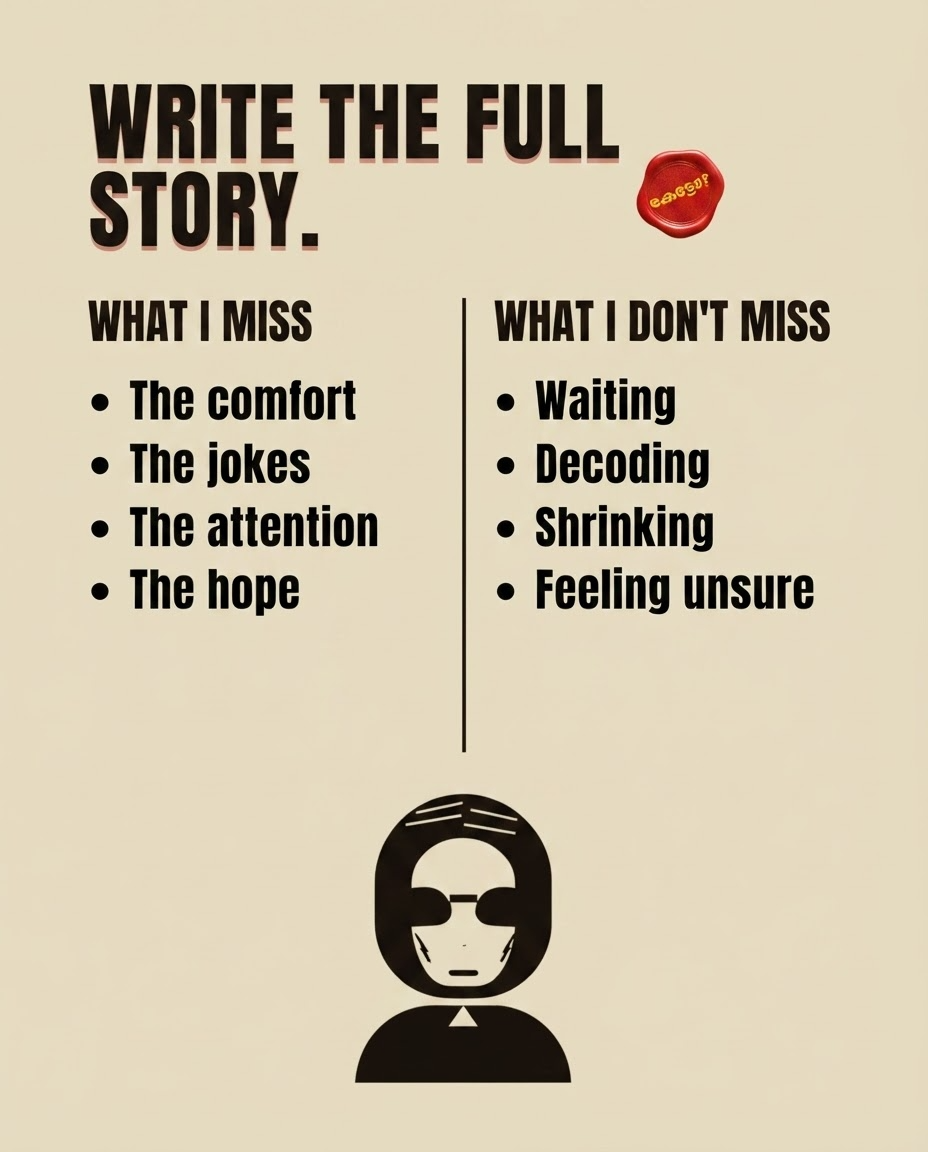
So write the full story.
Not the angry version. Not the romantic version. The full version.
Make two columns:
What I miss
- His humour
- The comfort
- The way he knew small things about me
- The physical closeness
- The hope
What I do not miss
- Waiting for replies
- Feeling unsure
- Explaining basic needs
- Shrinking my expectations
- Being scared to ask where we stood
Keep this note where you can read it when nostalgia starts wearing perfume.
Weeks two to four are also when you rebuild small routines. Do not try to become a brand-new woman by next Thursday. Just return to one thing that was yours before him. Cooking. Walking. Reading. Skincare. Church. Gym. Friends. Work. Your dog. Your plants. Your own silly YouTube history.
Your life needs familiar hooks that do not have his name on them.
Month 2: the quiet can feel uncomfortable
Month two is tricky because people around you may assume you are fine.
The first wave of sympathy reduces. Friends stop checking every day. Work expects you to function. Family may not even know the full story. Meanwhile, you may still be carrying him quietly through ordinary tasks.
This is the month where you may think, “Maybe I should just message him. Enough time has passed.”
Ask yourself why.
Do you want to speak to him from peace, or from loneliness? Do you want a real conversation, or do you want proof that he still cares? Do you miss him, or do you miss being chosen by him?
There is no shame in wanting the message. But wanting something does not make it wise.
Month two is for rebuilding your attention. Start asking different questions:
- What did I stop doing while loving him?
- Which friendships need care again?
- What did this relationship teach me about my patterns?
- Which boundary did I ignore too many times?
- What kind of love do I want next?
- What kind of love will I not negotiate with again?
This is also when your body may begin to relax. You may laugh without guilt. You may enjoy a meal without remembering him halfway through. You may go a few hours without checking your phone.
Do not punish yourself for feeling better. Grief does not need daily attendance to prove it was real.
Months 3 to 6: the story becomes clearer
Between months three and six, the breakup often becomes less foggy. You may start seeing the relationship more honestly.
You may realise you were not asking for too much. You may see how often you excused him. You may notice where you stayed quiet to keep peace. You may also see your own mistakes with more softness and less self-attack.
This stage is not only about getting over him. It is about understanding what happened to you inside that relationship.
Ask:
- Where did I abandon myself?
- What did I keep hoping he would become?
- Which red flags did I rename as “complicated”?
- What did I need that I was afraid to ask for?
- What did I learn about my own attachment?
- What would I do differently next time?
Be careful here. Reflection is useful. Obsession is just reflection that forgot to go home.
Set a time limit if you need to. Journal for 20 minutes. Talk to a friend. Then go live your day. You do not need to solve the entire relationship every evening like a family property dispute.
By now, you may also feel ready to remove more reminders. Gifts, photos, chats, playlists, screenshots. You do not have to burn your whole past. Just stop keeping painful things in easy reach.
Your room should not be a museum of someone who left.
After 6 months: what healing can look like
After six months, healing may look quieter than you expected.
You may not get a dramatic final moment where you wake up and feel nothing. More often, you notice small freedoms. You forget to check. You hear his name and do not lose the whole afternoon. You see a photo and feel something, but it does not pull you under. You stop rehearsing what you would say if he came back.
The story becomes part of your life instead of the room your life is trapped inside.
This does not mean you will never miss him. Some loves leave echoes. But an echo is not an instruction to return.
After six months, you may be ready to date again. Or not. You may want to focus on work, friends, family, health, faith, money, home, or yourself. Do not rush into a new person just to prove the old person lost access.
Date when your curiosity is stronger than your need to be rescued.
And when you do date, watch your own patterns kindly. If you start chasing unavailable people again, pause. If you feel bored by someone consistent, notice that too. Peace can feel unfamiliar when your last relationship trained you to survive on uncertainty.
What if healing goes backwards?
Healing can feel like it goes backwards when a trigger hits.
A birthday. A festival. A place. A song. A mutual friend’s wedding. A photo from two years ago. His new relationship. Your own loneliness. A random Tuesday with too much time and not enough dinner.
You may feel fine for weeks and then cry again. That does not erase your progress.
Progress means you recover faster. You do not stay on the floor as long. You know which friend to call. You know not to check his profile. You know sleep will help. You know the feeling will pass even if it is loud right now.
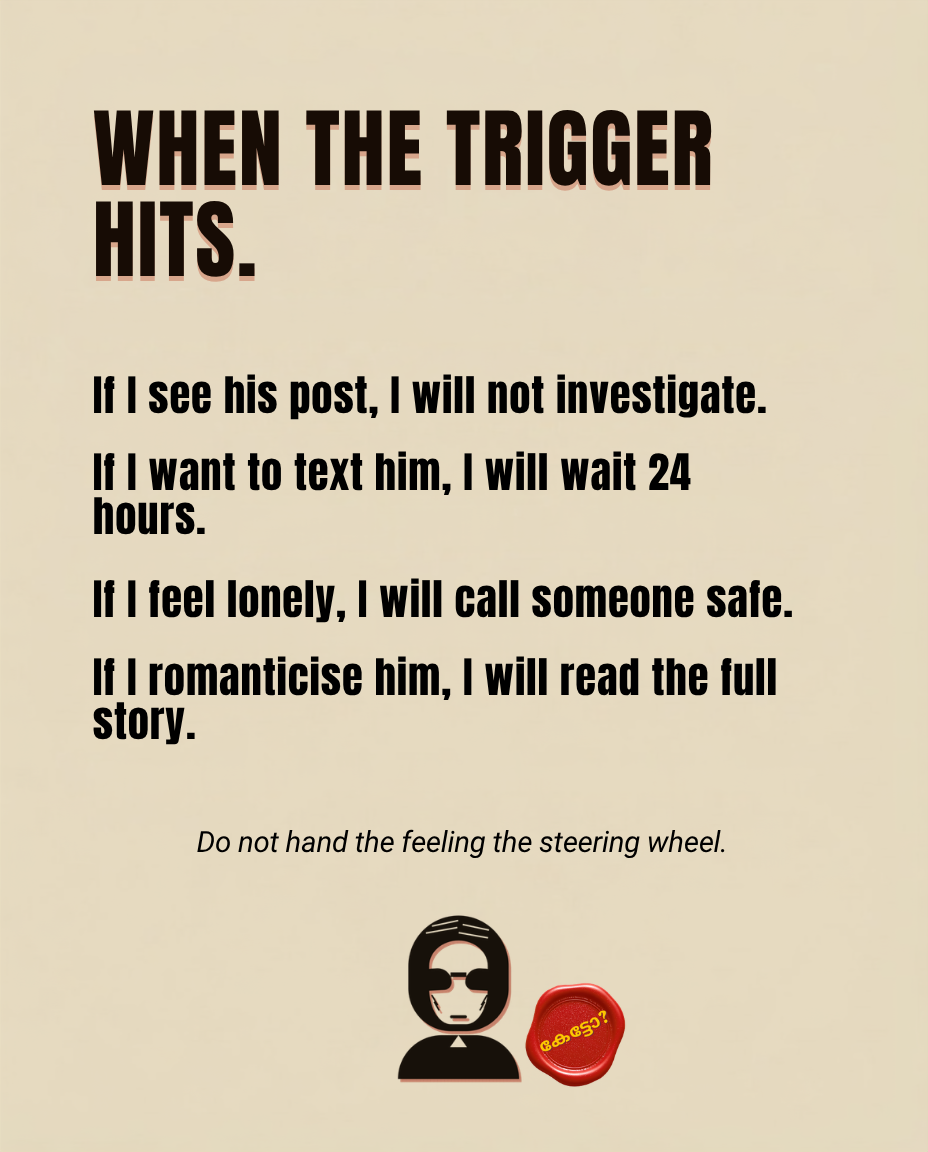
Make a trigger plan:
- If I see his post, I will not investigate
- If I want to text him, I will wait 24 hours
- If I feel lonely, I will call someone safe
- If I romanticise him, I will read the full story note
- If I feel stuck for many days, I will ask for support
The aim is not to never feel hurt again. The aim is to stop letting hurt drive the car.
Should you go no-contact after a breakup?
Go no-contact if contact keeps you stuck, hopeful, angry, or unable to accept the breakup.
Some people can stay civil after a clean ending. Many cannot, at least not immediately. If every message makes you analyse tone, if every story makes you wonder who he is with, if every “hope you are okay” sends you back into longing, distance will help more than politeness.
No-contact can include:
- Not texting
- Not calling
- Not checking his social media
- Not asking mutual friends for updates
- Not replying to emotional breadcrumbs
- Not using birthdays or festivals as excuses
If you share work, rent, pets, documents, or family responsibilities, use low-contact. Keep communication short, practical, and limited to the shared responsibility.
You are not rude for needing distance. You are not immature for removing access. You are a person trying to heal without reopening the same door every night.
What should you stop doing during breakup recovery?
Stop turning pain into investigation.
Do not check who he followed. Do not compare yourself to his new likes. Do not decode captions. Do not ask friends if he looked sad. Do not reread chats looking for the exact moment it broke. Do not keep watching your own stories to see if he viewed them.
Also stop auditioning for his regret. You do not need to become hotter, busier, more successful, or more mysterious just so he realises what he lost. Improve your life because it belongs to you.
Common habits to stop:
- Reopening old conversations
- Checking his profile through other accounts
- Posting only to get his attention
- Keeping his chat pinned
- Sleeping with the phone in your hand
- Asking for closure from someone who already refused honesty
- Calling every weak moment “love”
Be gentle with yourself, but be firm with the habit.
What helps you recover faster?
The basics help more than the dramatic things.
Sleep. Food. Movement. Sunlight. Clean clothes. A friend who does not romanticise the situation. A room that does not look like the breakup happened five minutes ago. A phone that is not constantly feeding you reminders.
Try this weekly recovery rhythm:
Body: eat regular meals, walk, stretch, sleep at a decent hour
Mind: journal the full truth, not only the sweet parts
People: meet one safe person, even if you do not feel entertaining
Space: clean one small area of your room
Phone: reduce checking routes
Future: plan one thing that has nothing to do with him
You do not need to become healed in one week. You need to become reachable to your own life again.
If the breakup is making it hard to function for a long time, or if you feel unable to stay safe, please involve a trusted person and professional support. Chechi can sit with you through the page, but you deserve real support around you too.
Common mistakes in breakup recovery
The biggest mistake is treating every feeling like an instruction.
You miss him, so you text. You feel angry, so you post. You feel lonely, so you check. You feel guilty, so you apologise for having needs. You feel nostalgic, so you rewrite the whole relationship as beautiful.
Feel the feeling. Do not hand it the steering wheel.
Other common mistakes:
- Trying to be friends immediately
- Looking for closure from the same person who caused the confusion
- Measuring healing by whether you still cry
- Staying in touch with his family too soon
- Posting for reaction instead of expression
- Jumping into dating only to avoid silence
- Forgetting the bad days when the loneliness hits
- Blaming yourself for not being “over it” fast enough
Breakup recovery needs patience and structure. Give yourself both.
A simple breakup recovery timeline
Use this as a guide, not a court order.
First 72 hours: stabilise
Eat, sleep, hydrate, tell one safe person, and avoid impulsive contact.
First week: protect
Mute or block if needed, plan evenings, remove easy checking routes, and do not make emotional decisions late at night.
Weeks 2 to 4: remember the full story
Write what you miss and what hurt you. Rebuild small routines that do not involve him.
Month 2: reclaim attention
Return to friends, work, body, hobbies, faith, home, and the parts of you that got quiet.
Months 3 to 6: learn the pattern
Notice what you ignored, what you needed, and what you will not repeat.
After 6 months: move with honesty
Date if you feel curious, not desperate. Stay single if that feels right. Let the story become a chapter, not your whole book.

More from Chechi
-
How to Go No-Contact and Actually Stick to It
No-contact is not about proving a point. It is about giving yourself enough distance to stop reopening the same wound. Chechi explains when to go no-contact, what to block, what to do when he texts, and how to stay steady when you miss him.
-
How to Leave a Situationship (Actually)
A situationship can feel like a relationship in private but leave you confused in real life. Chechi explains how to ask for clarity, leave without over-explaining, detach properly, and stop waiting to be chosen.