

How to Go No-Contact and Actually Stick to It
Go no-contact when staying connected keeps you anxious, hopeful, confused, or available to someone who cannot meet you properly. No-contact means no texting, no calling, no checking his stories, no asking friends for updates, and no sending one “mature” message just to see if he replies. It is not drama. It is distance with a purpose.
No-contact is not about proving a point. It is about giving yourself enough distance to stop reopening the same wound. Chechi explains when to go no-contact, what to block, what to do when he texts, and how to stay steady when you miss him.
Go no-contact when staying connected keeps you anxious, hopeful, confused, or available to a man who has already shown you he cannot meet you properly.
No-contact means no texting, no calling, no checking his stories, no asking friends what he is doing, and no sending one “mature” message just to see if he replies. You are not being dramatic. You are removing the daily route back to the thing that keeps hurting you.
If talking to him keeps pulling you back into the same loop, stop feeding the loop, mole. Put the phone down and give your heart a clean room to recover in.
What does no-contact actually mean?
No-contact means you stop giving him access to you while you heal.
That sounds simple, but this is where the bargaining starts. You may tell yourself, “I am not speaking to him. I am only checking his profile.” Your body does not experience that as distance. If one story, one like, one new follow, or one online status sends you into detective mode, that is still contact.
No-contact usually means:
- No texting him
- No calling him
- No replying to casual messages
- No checking his Instagram, WhatsApp, LinkedIn, Spotify, or any other place where your mind can go hunting
- No asking friends for updates
- No rereading old chats
- No sending birthday wishes as a secret emotional test
- No saving one small doorway because maybe he will finally understand
This is not about becoming cold. This is about becoming honest. If access to him keeps you stuck, access has to change.
When should you go no-contact?
Go no-contact when every interaction leaves you more restless than before.
You do not need one giant final betrayal to justify it. Many women wait for a big, cinematic reason because small daily disrespect feels harder to explain. But slow confusion can exhaust you too. So can mixed signals. So can being half-loved, half-chosen, half-held.
You may need no-contact if:
- You keep waiting for him to text
- You feel fine only when he gives you attention
- He comes back whenever you start moving on
- You reread old chats and call it “processing”
- You accept crumbs because crumbs feel better than silence
- You keep drafting the perfect message that will finally make him care
- You know the story is over, but your habits have not accepted it
Ask the real question before you touch the phone: “Is contact helping me heal, or is contact keeping me hooked?”
If the answer is hooked, Chechi is already looking at you over her glasses.
Is no-contact immature?
No-contact becomes immature when you use silence as a trick to make him chase you. It becomes healthy when you use silence as a boundary to protect your peace.
There is a difference between disappearing as performance and stepping away because you cannot keep doing the same thing to yourself.
A game says, “Let me vanish so he panics.”
A boundary says, “I cannot stay available to this pattern.”
You can care about him and still stop replying. You can wish him well and still block the road back into confusion. You can be soft-hearted without leaving your whole life unlocked.
That is the part many women struggle with. You think kindness means access. It does not. Sometimes kindness to yourself looks like removing the option to betray yourself at 11:47 pm.
Should you tell him before going no-contact?
Tell him only if a clear closing message will help you hold the boundary. Do not send a long explanation because you are secretly hoping he will finally respond with the exact sentence you needed three months ago.
Before sending anything, ask yourself: “Am I informing him, or am I fishing for a reaction?”
If you are fishing for a reaction, do not send it. Write the message in your Notes app, drink water, wash your face, and leave the phone alone.
If a message is needed, keep it short:
“I need space to move on, so I will not be staying in touch. Please do not call or text me. I wish you well.”
That is enough.
No emotional thesis. No timeline of every wound. No final paragraph designed to make him realise your value. If he did not understand while having access to you, one beautiful paragraph may not become the temple bell you want it to be.
Say the boundary. Then live inside it.
What should you block or mute?
Block or mute every route that keeps pulling you back.
This may include his number, WhatsApp, Instagram, Snapchat, Telegram, email, LinkedIn, old photo folders, playlists, chat backups, and the one random app where you can see his profile picture if you zoom in like CID.
Your willpower is not the only issue. Easy access is the issue. Do not make healing depend on you being strong every minute of the day.
Start here:
- Archive or delete the chat if rereading hurts you
- Mute or block his social profiles
- Remove his number if seeing his name tempts you
- Move photos out of your main gallery
- Remove app shortcuts that lead to checking
- Ask one trusted friend not to give updates
- Stop visiting places online just to “accidentally” see him
If blocking feels too harsh, begin with mute, restrict, archive, and delete shortcuts. But be honest with yourself. If you know you will keep finding the window, close the window properly.
Peace sometimes needs a password.
How long should no-contact last?
Start with 30 days, but do not treat day 31 like a reunion invitation.
Thirty days gives your mind enough space to stop treating him like a daily emergency. The first stretch may feel strange because your habits are still trained around checking, waiting, decoding, and hoping. Your fingers may reach for the phone before your dignity has even had breakfast.
During the first month, you may feel relieved one day and desperate the next. You may suddenly remember only his sweet side. You may feel convinced that one message will not matter. You may tell yourself you just need “closure.”
This is the important part: missing him is not an instruction.
At the end of 30 days, do not ask, “Do I still miss him?” You might. Ask better questions:
- Am I calmer than before?
- Am I sleeping better?
- Am I checking my phone less?
- Would one message undo my progress?
- Am I hoping contact will restart the story?
- Do I want to speak to him from peace, or from panic?
If the answer still points to panic, continue no-contact. Healing is not a school assignment with a submission date.
What do you do when he texts?
Do not reply immediately. Most no-contact breaks happen in the first five minutes after his name appears on the screen.
The message may look harmless:
“Hey.”
“You okay?”
“Saw this and thought of you.”
“Can we talk?”
“I miss you.”
Your mind may start decorating the message with meaning. Suddenly “hey” becomes regret, growth, destiny, and three imaginary conversations.
Slow down before you answer. Ask yourself:
- What is he actually saying?
- Has anything changed?
- Does this message respect my boundary?
- Will replying help me heal?
- Would I advise my best friend to reply?
If the answer is no, do not reply.
If logistics require a response, keep it practical:
“Please send the document by email.”
“I will leave your things with security.”
“I am not available for a personal conversation.”
Use fewer words than your emotions want. You do not need to add extra warmth to prove you are not bitter. You do not need to add a smiley so he feels comfortable with the boundary. Let the sentence do its job and stop there.
What if you break no-contact?
If you break no-contact, do not turn one slip into a full return.
This is where shame can make things worse. You reply once, feel foolish, decide the boundary is ruined, and then keep talking because “anyway I already failed.” That is how one message becomes one more month of confusion.
A slip is information. Treat it like information.
Do this:
- Stop the interaction
- Do not explain your guilt to him
- Write down what triggered you
- Block or mute the route you used
- Tell one safe friend if you need support
- Restart without insulting yourself
Talk to yourself firmly, not cruelly. Say, “I slipped because evenings are hard. I need a plan for evenings.” Do not say, “I have no self-respect.” Shame makes you weaker. Practicality gives you a handle.
Chechi is not asking you to be perfect. Chechi is asking you to come back faster.
What should you do instead of texting him?
Replace the habit, not the person.
When you want to text him, pause and name the real need. Are you lonely? Are you bored? Are you angry? Are you missing the version of him that showed up in the beginning? Are you hoping he will say one sentence that makes the last few months hurt less?
Once you name the need, choose the right response.
If you are lonely, call a friend.
If you are restless, walk for ten minutes.
If you are angry, write the message and do not send it.
If you miss the good version of him, write the full version too, including the parts that hurt you.
If you are bored, admit that some “I miss him” is just late-night Wi-Fi and an empty evening.
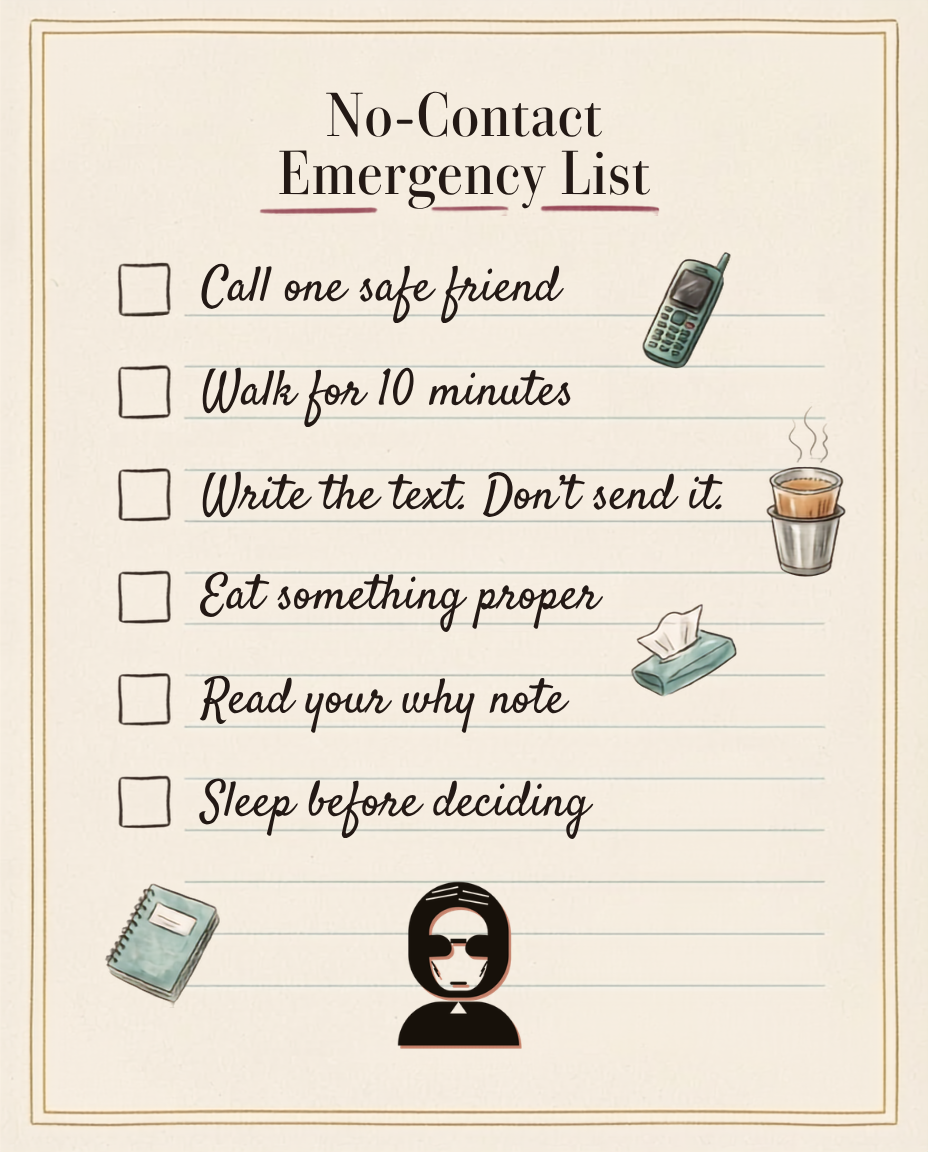
Make a no-contact emergency list before the urge comes:
- One friend you can message instead
- One comfort show or podcast
- One physical task like folding laundry, showering, or walking the dog
- One note titled “Read before you text him”
- One list of reasons you chose distance
- One rule that you will not make emotional decisions after midnight
This sounds basic because healing is often basic. Eat something proper. Sleep. Move your body. Clean your room. Cry if needed. Repeat the boring things until your life starts feeling like yours again.
What if you have mutual friends?
Tell your friends clearly that you do not want updates about him.
You can say:
“I am taking space from him, so please do not tell me what he is doing unless it is genuinely important.”
This protects you from accidental setbacks. It also protects your friends from becoming the news channel for your pain.
Do not ask clever questions through friends. No “Was he sad?” No “Did he ask about me?” No “Was he with someone?” You are not collecting neutral information. You are feeding the exact part of you that no-contact is trying to calm.
If you share a friend group, prepare before events. Go with someone safe. Keep conversation polite and short. Leave early if you need to. Do not drink so much that your boundary becomes a suggestion. You do not have to perform being unaffected. You only have to protect your recovery.
Your peace can be quiet. It does not need witnesses.
What if you work together or cannot avoid him?
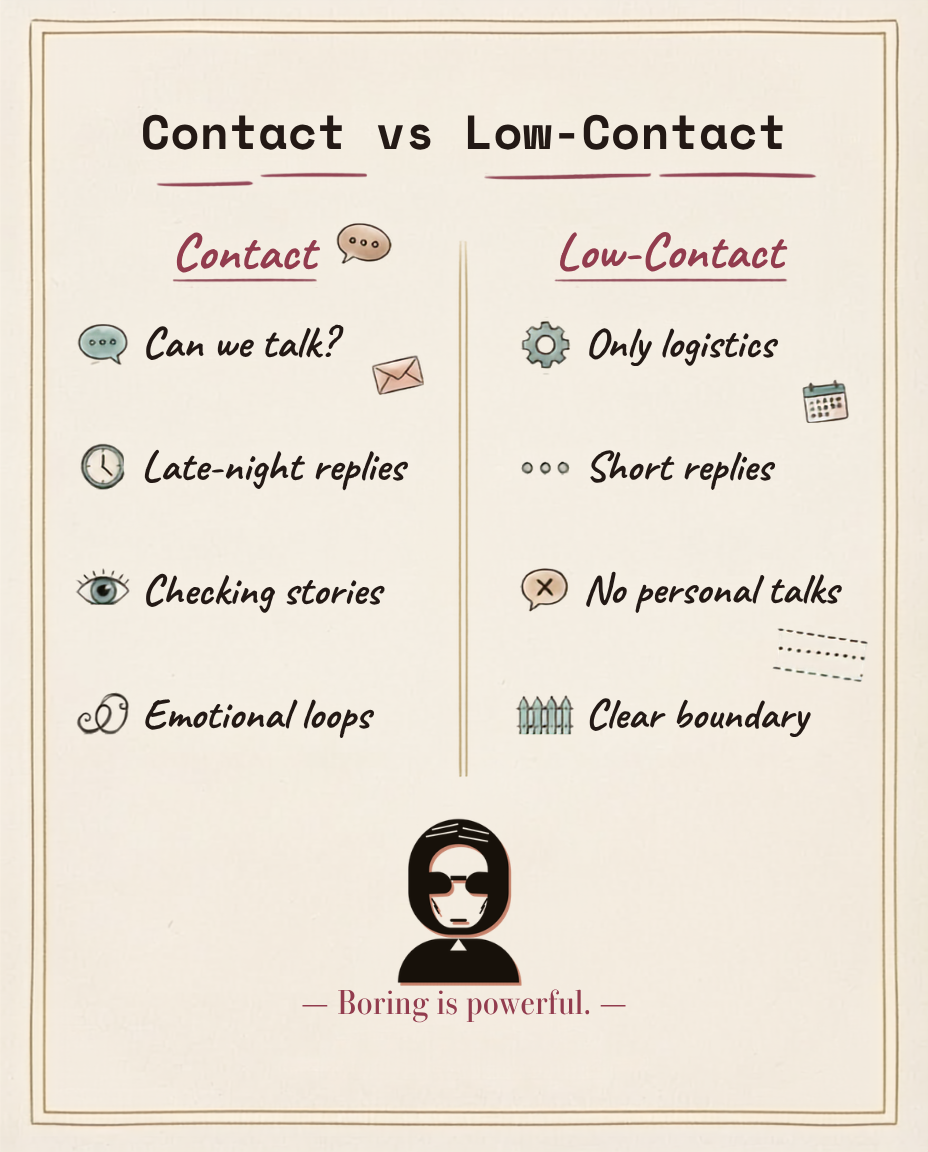
If you cannot fully avoid him, use low-contact.
Low-contact means communication stays necessary, brief, and boring. This applies when you work together, study together, co-parent, share rent, share pets, or need to handle belongings, money, documents, or other logistics.
Use the “office email” method. Even if the conversation is on WhatsApp, write like HR is standing nearby with a cup of tea.
Try:
“Please confirm the payment by Friday.”
“I will collect my things on Saturday at 11.”
“Let us keep this conversation about the project.”
“I am not discussing the relationship here.”
Do not process feelings in a logistics chat. Do not let one practical message become a late-night emotional debrief. Do not answer personal questions just because he added your name at the end like a sad movie hero.
Keep it clean. Keep it short. Keep it boring.
Boring is powerful because drama cannot find a handle.
What if he apologises?
A sincere apology deserves to be heard only if you are steady enough to hear it.
Do not confuse emotional volume with repair. A man can miss you and still repeat the same pattern. A man can cry and still avoid accountability. A man can say “I am sorry” because he feels lonely, not because he understands the damage.
Look for specifics, not poetry.
A useful apology sounds like:
“I hurt you when I disappeared and came back like nothing happened. I understand why you need space. I will respect that.”
A weak apology sounds like:
“Sorry if you felt bad.”
“I was going through a lot.”
“You know I never meant to hurt you.”
“I miss us.”
The first one takes responsibility. The others mostly try to soften the consequences.
Even if the apology is good, you do not have to reopen contact immediately. You can accept an apology and still choose distance. Forgiveness does not come with automatic entry.
How do you know no-contact is working?
No-contact is working when your life slowly becomes about you again.
At first, it may feel worse because the distraction is gone. You may have more silence than you know what to do with. But after some time, small signs appear.
You check your phone less. You stop rehearsing imaginary conversations. You laugh without immediately wanting to tell him. You make plans without wondering if he will text. You remember your appetite, your taste, your work, your friends, your body, your future.
You may still miss him. That does not mean the boundary failed. It means you are human.
The point is not to hate him. Hate is also a tie. The point is to become free enough that his presence or absence does not decide the weather inside you.
That kind of peace arrives slowly, but it arrives.
Common mistakes during no-contact
The biggest mistake is keeping secret windows open.
You block his number but check his Instagram. You delete the chat but keep the photos in your favourites. You say you are done but ask a friend for “one tiny update.” You call it curiosity, but your heart knows what it is doing.
Other common mistakes:
- Making a dramatic announcement before you have a real plan
- Using no-contact to make him jealous
- Counting days while secretly waiting for him to come back
- Romanticising the good parts and editing out the disrespect
- Drinking and texting
- Keeping his gifts in your daily line of sight
- Treating loneliness as proof that you chose wrong
- Replying warmly to “harmless” messages that reopen the loop
Loneliness is not proof that you made the wrong decision. Sometimes it is just the sound of space being created.
Let your life fill that space slowly.
A simple no-contact plan
Keep the plan simple enough to follow on a weak day.
Day 0: Decide clearly
Write one line for yourself: “I am going no-contact because contact keeps hurting me.”
Day 1: Remove access
Mute, block, archive, delete shortcuts, move photos, and close the routes you keep using.
Day 2: Tell one safe person
Ask that friend not to give updates, not to encourage “one last talk,” and not to romanticise the situation when you are vulnerable.
Week 1: Survive the urges
Do not make big emotional decisions late at night. Use your emergency list before you use your phone.
Week 2: Rebuild routine
Eat properly, sleep at a reasonable hour, move your body, clean one corner of your room, and return to one thing that feels like you.
Week 3: Watch the fantasy
Your mind may start showing you only the sweet parts. Write the full story, including the moments that made you choose distance.
Week 4: Reassess honestly
Ask if contact would help you move forward, or if it would restart the same loop with better lighting.
If you are still shaky, continue. No-contact lasts as long as your healing needs protection.