

After Unprotected Sex: Facts First, Shame Never
After unprotected sex, act according to the clock. Take a levonorgestrel emergency contraceptive pill as soon as possible and within 72 hours, or speak to a doctor about a copper IUD within five days. Consider HIV PEP within 72 hours if the exposure was high-risk, and take a pregnancy test three weeks later or when your period is over a week late.
The condom broke, the pill was missed, or the plan disappeared in the moment. Here is what to do after unprotected sex in India, from emergency contraception and pregnancy testing to STI care, abortion rights, and getting around judgemental providers. Facts first. Shame never.
Chechi is your sister, not your doctor.
Everything below is general information drawn from the World Health Organization, India's Ministry of Health and Family Welfare guidelines, and published research cited at the end. Your body and your situation are specific, so when in doubt, talk to a gynaecologist. Yes, even if you are unmarried. Especially then.
So it happened. The condom broke, or slipped, or was never there, or you missed pills, or the moment ran ahead of the plan. And now your brain is running its own horror film at 3 am.
It's okay, breathe. Chechi needs you to understand one thing before anything else: shame is a terrible project manager. It makes you delay, hide, Google in incognito until 4 am, and miss windows that actually matter.
So we are going to put shame outside the room and deal in hours and facts.
But Chechi also refuses to pretend the errand is simple. "Just go to the pharmacy" assumes the pharmacy will cooperate, and in large parts of this country, it won't. So this guide comes in two layers: what to do, and how to get it done when the system itself becomes the obstacle. Both layers matter, because the clock does not pause for other people's morality.
The first 72 hours: your action window
If pregnancy is possible from what happened, you have options, and they are time-sensitive.
The emergency contraceptive pill (ECP). In India this is a levonorgestrel tablet, sold under brand names like i-pill and Unwanted-72. It is legal to buy over the counter across India, no prescription and no husband required. In 2025, the central drug authority (CDSCO) reviewed and rejected a proposal to make these prescription-only, so the law is firmly on your side. The pill works best the sooner you take it: most effective within 24 hours, effective up to 72. After that, effectiveness drops sharply. This is a today errand, not a this-weekend errand.
How it works matters, because misinformation has done enormous damage here. The ECP delays or prevents ovulation, meaning it stops a pregnancy from starting. It does not end an existing pregnancy, it is not the abortion pill, and it will not harm a pregnancy that has already begun. Hold onto this fact; you may need to say it out loud to a pharmacist.
The copper IUD. Less known, more effective. A copper IUD inserted by a doctor within 5 days of unprotected sex is the most effective emergency contraception that exists, and it then works as regular contraception for years. It needs a gynaecologist visit, which makes it the right choice if you can get an appointment fast and were considering long-term contraception anyway.
The access reality: when the pharmacy says no
Now the second layer. India's law says the pill is yours to buy. India's counters often disagree, and you should know this before you waste your window discovering it.
The "looking married" test. Reporting from across the country has documented pharmacists refusing or shaming women they judge to be unmarried, mislabelling the ECP as an abortion pill, or claiming it is banned when it is not. Researchers who study emergency contraception in India have found that judgmental provider attitudes measurably discourage women from using a legal, safe medicine. A survey of doctors in North India found many held misconceptions about the pill and disapproved of the women who use it. Translation: the person behind the counter may have opinions. Their opinions are not the law, and they are not your problem to fix at hour 30.
The Tamil Nadu shadow ban. There is no official ban in the state, but in practice ECPs vanished from shelves years ago. A pharmacy audit by the Foundation for Reproductive Health Services India found only about 3% of Tamil Nadu pharmacies stocked ECPs; a news check of 23 Chennai pharmacies found exactly one that even claimed it could try to source one. If you are in Tamil Nadu, do not spend your window walking from shop to shop. Go straight to a gynaecologist, a private clinic, or a telemedicine consultation.
Small towns and villages. The stocking problem is not only a Tamil Nadu story. Availability thins out fast outside metros, and national survey data (NFHS-5) shows more than half of Indian women have never even heard of emergency contraception, which tells you how little the system has invested in you knowing your options.
So here is Chechi's access playbook, in order:
- Try a large chemist or 24-hour pharmacy first, ideally attached to a hospital. Ask plainly for "i-pill or Unwanted-72." You do not owe anyone your marital status, your reasons, or eye contact.
- Send someone if you can't face it. The pill does not check who paid. A friend, your partner, anyone. This is exactly what friends are for.
- Use quick-delivery and online pharmacy apps if you are in a city they serve. A delivery bag does not moralise.
- If pharmacies fail, go clinical: a gynaecologist, a government hospital or urban health centre (ECPs are part of the national family planning programme and government facilities are the second-largest source of them in the country), or a telemedicine consultation that can arrange the medicine.
- If one counter refuses you, leave immediately and try the next. Do not stand there absorbing a lecture. Every minute of that sermon costs you effectiveness.
What the pill will feel like
Taking the ECP is not a dramatic event, whatever the aunty whisper network says. Common side effects are mild and short: some nausea, tiredness, headache, breast tenderness, or spotting. If you vomit within two hours of taking it, the dose may not have absorbed, so take another.
The most common after-effect is that your next period behaves like it has been through something, because it has. Early, late, heavier, lighter: all normal, all temporary. What the pill will not do is affect your future fertility. That myth has scared generations of women out of protecting themselves, and it deserves retirement.
One honest limitation: the ECP is much less effective than regular contraception, and using it as your main method means more risk and a very confused cycle. It is the fire extinguisher, not the smoke alarm. Use it without guilt when you need it, then set up something regular.
The next three weeks: watching, not panicking
After the pill comes the waiting, and Chechi knows the waiting is the worst part. Here is the schedule, so your anxiety has less room to freelance.
Your period. If it arrives within a week of its expected date, even a strange version of it, you are almost certainly fine.
If it is more than a week late, take a home urine pregnancy test. Cheap, accurate, available at any pharmacy without conversation. For a reliable answer, test three weeks after the sex in question; testing on day four tells you nothing except that you are anxious, which you already knew.
One symptom that skips the queue: severe one-sided abdominal pain, especially with dizziness or unusual bleeding, needs a doctor immediately, not a waiting period.
If the test is positive: your rights, in writing
You have options, and you have more legal protection than most people, including some doctors, will tell you. So Chechi is putting your rights where you can find them.
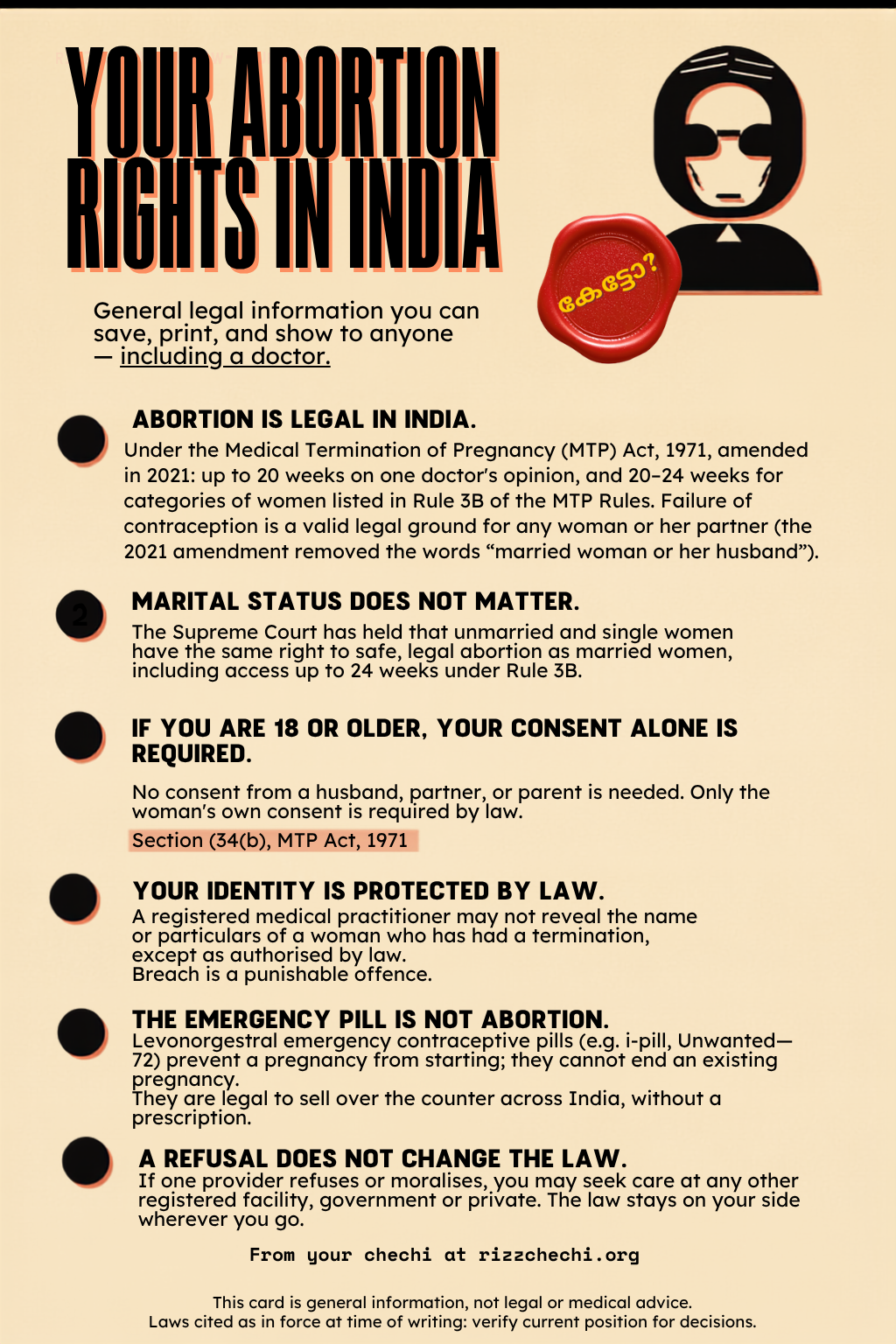
Abortion is legal in India under the MTP Act, on broad grounds that include contraceptive failure, up to 20 weeks in the standard case and 24 for specified categories.
It is legal for unmarried women. The Supreme Court ruled in 2022 that unmarried women have the same abortion rights as married women, because reproductive autonomy does not check your mangalsutra.
As an adult, your consent is the only consent required. Not a husband's, not a parent's, not a boyfriend's.
And your confidentiality is protected by law (Section 5A of the MTP Act); a facility demanding to inform your family is violating it, not following procedure.
Why is Chechi writing this out like a rights card? Because denial happens. Reporting in The Week documented government doctors turning away women, including unmarried women, with confident false statements like "it is not legal after three months" or "there is no provision for unmarried women." Neither statement is true. Because abortion in India is framed as a doctor's permission rather than a woman's right, providers face no penalty for wrongly refusing, and studies show unmarried women overwhelmingly end up in private clinics or attempting it alone at home. Rural India adds another wall: government health statistics show a shortage of roughly 70% of the required gynaecologists in rural areas, so the nearest legal provider may be a bus journey away.
None of this means you are stuck. It means: if a provider refuses or moralises, that is a defective provider, not a closed door. Try a private clinic (early medical abortion can cost surprisingly little), a women's hospital, or a different government facility. Early pregnancy gives you time to make one more phone call.
One line Chechi will not soften: do not buy MTP kits informally and take them alone. Unlike the ECP, abortion pills genuinely need medical supervision for your safety, and self-administered kits are exactly where access failures push desperate women. The workaround for a broken system is a better provider, not an unsupervised pill.
The shame audit
Now the part that is not medical but decides everything medical: what shame will try to make you do this week.
Shame will tell you to skip the pharmacy because the uncle at the counter might judge. He might; you have read the evidence above. But notice that he sold a man a strip of condoms twenty minutes ago without a single question. The judgment was never about the medicine. It is about who is asking. Buy the pill, or route around him using the playbook.
Shame will tell you not to see a gynaecologist because "what will she think of an unmarried girl asking this." A decent doctor thinks: patient, Tuesday, next. If you meet a judgemental one, that is a defective doctor, not evidence against you. Change doctors, not decisions.
Shame will tell you to carry the waiting weeks completely alone. You are allowed one trusted person. Panic shared is panic halved, and someone should be bringing you tea while you wait for a test result.
And shame will tell you this situation is proof you are careless or bad at being a good girl. It is proof of exactly one thing: you had sex and something went imperfectly, which is one of the most common human experiences ever recorded. The difference between the women this destroys and the women it doesn't was never virtue. It is information, which you now have.
One question Chechi has to ask
Everything above assumes the sex was something you chose. If it was not, if you were pressured, forced, or too impaired to consent, then what happened to you was not a contraception problem, and it was not your fault. The medical steps above still apply and still matter, but you also deserve support: a hospital can provide care without you deciding anything about reporting on the spot, the national Women Helpline is 181, and if you need someone to talk to, iCall (9152987821) and Tele-MANAS (14416) are free and confidential. Take just one step. You do not have to take all of them today.
The whole guide in one breath: pill within 72 hours, sooner is better, copper IUD within 5 days if you can, route around unhelpful counters without absorbing lectures, period watch for three weeks, test if it is a week late, know your MTP rights before anyone misquotes them at you, STI check if status is unknown, PEP within 72 hours if HIV risk is real, one trusted person, zero shame errands.
The system should be easier than this, and Chechi will keep saying so loudly. But tonight, you do not need the system fixed. You need the next step, and now you have it.
You did not become a different woman the night the condom broke. You became a woman with a to-do list. Finish the list, drink some water, and be kind to the girl in the mirror. She handled it.
Citations:
"In 2025, the central drug authority (CDSCO) reviewed and rejected a proposal to make these prescription-only" — and ulipristal being added to Schedule H: The South First, "Emergency contraceptive pills remain over the counter despite Tamil Nadu's push for restriction" (Dec 2025) https://thesouthfirst.com/health/emergency-contraceptive-pills-remain-over-the-counter-despite-tamil-nadus-push-for-restriction/
"Reporting from across the country has documented pharmacists refusing or shaming women they judge to be unmarried" (the "looking married" test, "it's banned," "it's an abortion pill"): Missing Perspectives, "The morning after: The struggle to find emergency contraceptive pills in India" (2022) https://missingperspectives.com/posts/the-morning-after-the-struggle-to-find-emergency-contraceptive-pills-in-india/
"Researchers... have found that judgmental provider attitudes measurably discourage women from using" ECPs: Meta-analysis discussed by Dr. Shrinivas Darak (Prayas, Pune), reported in The South First (Oct 2024) https://thesouthfirst.com/health/7-out-of-1000-women-seek-emergency-contraceptive-pills-in-india-57-percent-obtain-them-from-otc/
"A survey of doctors in North India found many held misconceptions about the pill and disapproved of the women who use it": Global Health: Science and Practice, "Medical barriers to emergency contraception: a cross-sectional survey of doctors in North India" (2014) https://www.ghspjournal.org/content/2/2/210 (open-access mirror: https://pmc.ncbi.nlm.nih.gov/articles/PMC4168613/)
"A pharmacy audit by the Foundation for Reproductive Health Services India found only about 3% of Tamil Nadu pharmacies stocked ECPs": The Citizen, "Accessing Contraceptives Under the Shadow Ban in Tamil Nadu" (2021), citing the FRHS India–Marie Stopes International survey https://www.thecitizen.in/index.php/en/NewsDetail/index/7/20438/Accessing-Contraceptives-Under-the-Shadow-Ban-in-Tamil-Nadu--
"A news check of 23 Chennai pharmacies found exactly one that even claimed it could try to source one": The News Minute, "The unsuccessful hunt for an emergency contraceptive pill in Chennai" https://www.thenewsminute.com/premium/unsuccessful-hunt-emergency-contraceptive-pill-chennai-165554
"National survey data (NFHS-5) shows more than half of Indian women have never even heard of emergency contraception" (and <1% ever used): "Do Indian women know about and use the emergency contraceptive pill? An analysis of nationally representative data from 2005–06 and 2019–21" (peer-reviewed, PMC open access) https://www.ncbi.nlm.nih.gov/pmc/articles/PMC10679928/
"Government facilities are the second-largest source of them in the country" (NFHS-5: 44.4% pharmacies/drugstores, 25.6% government institutions, 57% OTC overall): The South First, "7 out of 1,000 women seek emergency contraceptive pills in India, 57 percent obtain them from OTC" (Oct 2024) https://thesouthfirst.com/health/7-out-of-1000-women-seek-emergency-contraceptive-pills-in-india-57-percent-obtain-them-from-otc/
"The Supreme Court ruled in 2022 that unmarried women have the same abortion rights as married women" and Section 5A confidentiality: Drishti IAS explainer, "Barriers to Abortion Access in India" (covers X v. Principal Health Secretary, NCT Delhi 2022, Section 5A, and Puttaswamy) https://www.drishtiias.com/daily-updates/daily-news-analysis/barriers-to-abortion-access-in-india (secondary explainer incl. the 2022 ruling and transgender-inclusive interpretation: https://socio.health/population-theories-policies-programme/safe-abortion-india-legal-access-mtp/)
"Reporting in The Week documented government doctors turning away women... with confident false statements" and "studies show unmarried women overwhelmingly end up in private clinics or attempting it alone at home" (Cureus study, ~90%): The Week, "Why safe abortion access remains a struggle for Indian women" (Aug 2025) https://www.theweek.in/health/more/2025/08/30/abortion-india-stigma-cost-mtp-challenges.html
"Providers face no penalty for wrongly refusing" (permission-based framing, provider gatekeeping): New Lines Magazine, "India's Abortion Laws Offer Pregnant Women an Illusion of Choice" (2024) https://newlinesmag.com/argument/indias-abortion-laws-offer-pregnant-women-an-illusion-of-choice/
"Government health statistics show a shortage of roughly 70% of the required gynaecologists in rural areas" (Rural Health Statistics 2019–20): Cited in the Drishti IAS explainer above https://www.drishtiias.com/daily-updates/daily-news-analysis/barriers-to-abortion-access-in-india
Medical basics (ECP mechanism, 72-hour window, copper IUD within 5 days, side effects, no fertility effect, not the abortion pill): WHO fact sheet on emergency contraception — https://www.who.int/news-room/fact-sheets/detail/emergency-contraception

More from Chechi
-
Too Indian for Tinder, Too Western for Shaadi.com
For the unmarried Indian woman dating between apps, family calls, biodatas, guilt, and “what will people say?” This is about the daughter split: adult in your own life, still on probation inside the family system.