

"All You Have To Do Is Ask" Is Not the Flex He Thinks It Is
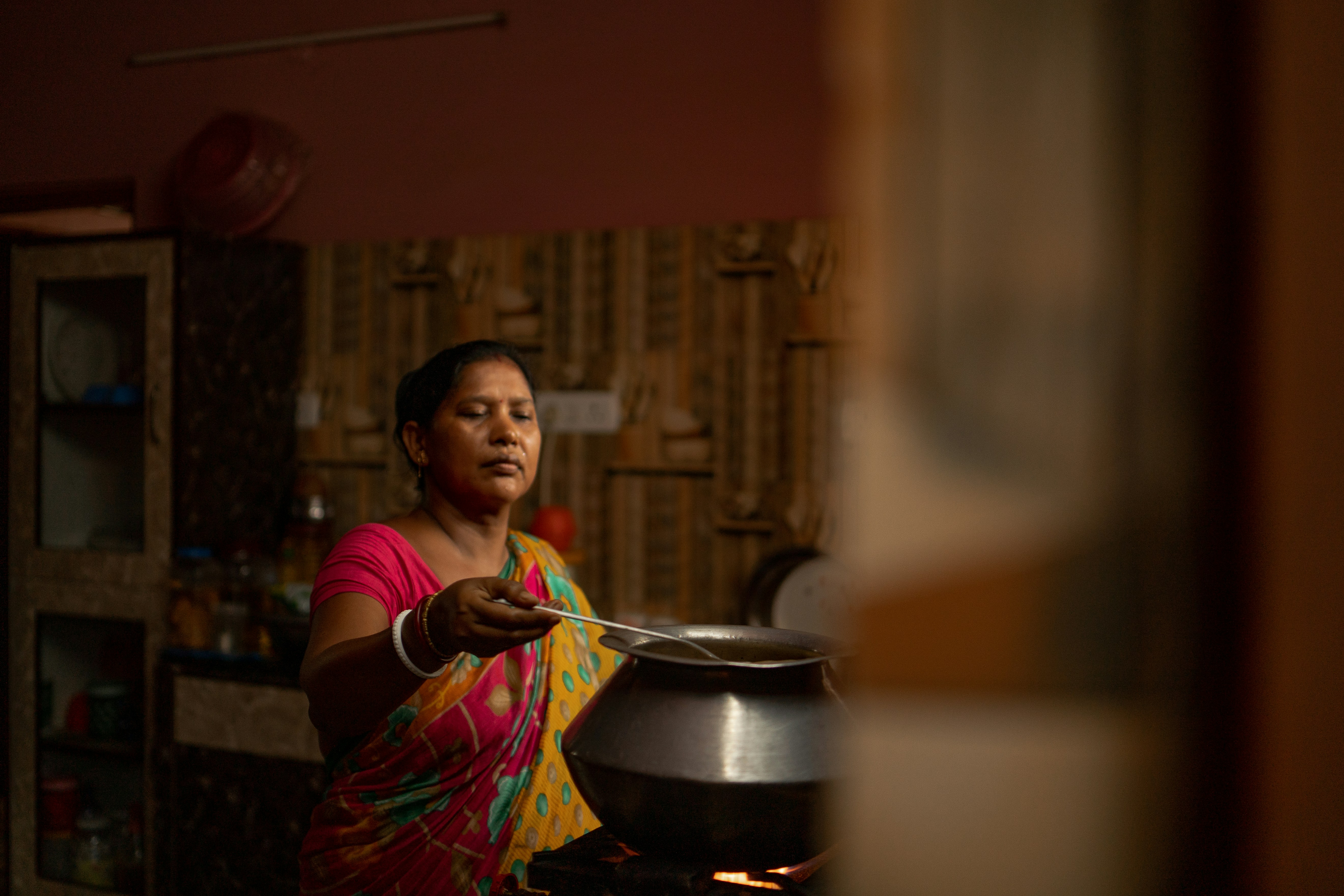
Housework in an Indian home is two jobs, and only one of them looks like work. Someone cooks, wipes, folds. Someone else has to know the atta is finishing, that the bai is off on Thursday, that the uniform needs washing tonight. Researchers call that second job cognitive labour, and the newest evidence says it is the half that does not move when a woman earns more.
Your father waits for tea. Your brother waits for someone to clear his plate. Your husband asks if you have made the grocery list. Nobody thinks they are doing anything, which is exactly what makes it so hard to argue about.
Housework in an Indian home is two jobs, and only one of them looks like work. One person cooks, wipes, folds. Someone has to know that the atta is finishing, that the bai is off on Thursday, that the school uniform needs washing tonight or there will be a scene at 7am. Researchers call that second job cognitive labour, and the newest evidence says it is the part that does not move. Women get promoted, start earning more, hire help, and still hold the entire list.
Your father wakes up, walks to the balcony, and waits. The tea arrives. It has arrived every morning of his adult life and he has never once wondered from where.
Your brother finishes eating and leans back. He will sit out the entire table if he has to, because standing up means carrying his plate to the sink, and that plate has never been his to carry.
Your husband asks if you have made the grocery list. Not whether the list needs making. Whether you have made it.
None of them think they are doing anything to you. That is exactly what makes it so hard to argue about.
The job with no name
Say a man does his share of tasks. He cooks on Sundays. He takes the bins down. He is proud of this and you are, in fairness, glad.
Now ask who noticed the bins were full.
The sociologist Allison Daminger broke this second job into a cycle: anticipating what the household will need, working out the options, making the call, then monitoring whether it actually happened. When she interviewed couples, she found the decision-making got shared fairly evenly. Men turned up for that part. The anticipating and the monitoring stayed with women.
Which is to say he arrives for the meeting and skips the eleven months of work that produced the agenda.
Two things about this have been established since your mother's generation gave up complaining about it.
The first is that this gap is wider than the gap in physical chores. A 2024 study of 322 mothers in the Archives of Women's Mental Health measured cognitive and physical labour across thirty common household tasks and found women's share of the thinking work was more lopsided than their share of the doing. The researchers also found cognitive labour tracking with depression, stress, burnout and how the relationship itself was functioning.
The second is worse. In October 2025, researchers at Bath and Melbourne published a study of 2,133 partnered heterosexual parents in Socius. When women worked more and earned more, their physical housework went down. Their cognitive load did not budge. Not with a job, not with a bigger salary, not with earning more than him.
They named it gendered cognitive stickiness. Once the mental work gets assigned to you, usually without anyone announcing it, it sticks. You cannot promote your way out. You cannot pay your way out.
So when he says "all you have to do is ask", hear what he is describing. He is available for assignments and you are management. You have to know the task exists, decide when it should happen, judge his mood, phrase it so it does not land like nagging, then check whether it happened. Four steps of labour before a single dish gets washed.
But, asking is the work. It has always been the work.
A detergent brand of all people put a number on the exhaustion of it. In an Indian survey run for Ariel's #ShareTheLoad campaign, 74 percent of women said they had given up talking to their partners about sharing the load at all. It is marketing research and I would not build a policy on it. But ask around your own building and see how wrong it feels.
We start the training early
Girls get taught skills. Cooking, cleaning, cutting vegetables the right thickness, folding a saree so it does not crease. Not to survive an apocalypse. To survive life as a woman. So that when she goes to another house, she should know something na?
Boys get taught to fix. Change that bulb. Check the inverter. Carry the heavy thing. All of it framed as manly, all of it occasional, all of it applauded when it happens.
Watch how differently the two get received. He changes a tube light once in eight months and someone tells the family WhatsApp group. She cooks twice a day for eleven years and it registers only on the day the dal is slightly off.
UNICEF put the first global numbers on the childhood version back in 2016. Girls between five and fourteen spend 550 million hours a day on household chores, which is 160 million hours more than boys the same age. In South Asia, girls between ten and fourteen do close to double what boys do. The gap opens before puberty, before marriage, before anyone has said one word out loud about gender roles.
Five years of data, ten minutes of progress
India runs a Time Use Survey that asks people to account for their day in half-hour slots. The 2024 round covered nearly 1.4 lakh households and 4.5 lakh people, so this is not a small sample with an agenda.
On the day they were surveyed, 81.5 percent of women aged six and above did some unpaid domestic work. Among men, 27.1 percent did.
Sit with that before you get to the minutes. Roughly three in four Indian men did no housework at all on an ordinary day. Not less housework. None.
Among the people who did some, women averaged 289 minutes and men averaged 88. Across the whole population, women gave 16.4 percent of their day to unpaid domestic work. Men gave 1.7 percent.
The trend line is where it gets bleak. Women aged 15 to 59 who did unpaid domestic work were putting in 315 minutes a day in 2019. In 2024 it was 305. Ten minutes recovered in five years.
Caregiving runs the same way. Among people aged 15 to 59, 41 percent of women were looking after someone at home on a given day, against 21.4 percent of men. The women who did it spent 140 minutes at it. The men spent 74.
Before anyone says this is just Indian culture
It is not, and that argument gets used to make the whole thing feel too large to fix.
Pew released fresh American numbers in March 2026. Women there do 2 hours 19 minutes of housework a day against men's 1 hour 34 minutes, and the gap is widest for people in their thirties and forties, exactly when careers are supposed to be peaking. UN Women's Gender Snapshot 2025 puts the global figure at two and a half times, and estimates that 708 million women are out of the labour force entirely because of care responsibilities. For men that figure is a rounding error.
So the pattern is everywhere. India is at the far end of it, which is a different claim and a fixable one.
Helping and owning are different things
A man who helps still lives in a house where the work belongs to someone else. He is doing you a favour. Favours can be withdrawn, negotiated, forgotten, or produced as evidence in a fight three weeks later.
Owning looks different. He takes a category, all of it, including the noticing. Groceries means knowing what is finished, buying it and putting it away, with no list appearing in his hand by magic. School means knowing the fee dates, the PTA timing, the uniform sizes. Kitchen means planning what gets cooked, not waiting to be told what to chop.
He will do it worse than you at first. He will buy the wrong coffee and forget the coriander. Let him. The alternative is taking it back, and taking it back is how the last decade went.
Vague splits do not survive contact with a Tuesday. Name the categories out loud, put them on paper if you must, and hand over the anticipating along with the doing. Anything less is a chore chart that you are still managing, which is the job you were trying to give away.
If you want evidence that this is movable: an economist at UT Arlington ran a randomised trial with 900 couples in Kanpur, where couples went through counselling designed to loosen gender norms at home. Men took on more domestic work afterwards, and household employment and income went up. Norms are not weather. People install them and people can change them.
The part that shows up at night
Nobody owes anybody sex for doing the dishes. Let us be clear, because there is a whole genre of internet advice implying that a man who mops has earned something afterwards. He has not.
What the research actually shows is subtler and more useful. A 2022 study of women partnered with men found that the more of the household labour a woman was carrying, the lower her desire for her partner, and the thing carrying that effect was her sense that the arrangement was unfair. Not tiredness alone. Unfairness.
A study published in The Journal of Sex Research this year sharpened it further. Women who wanted an equal partnership and had one reported the highest desire for their partners. Women who wanted an equal partnership and were doing more than their share reported the lowest. Among mothers, doing more of the household labour tracked with lower desire regardless of what they believed about gender roles.
Read that carefully, because it is not a transaction. Chores are not currency. The mechanism is that it is difficult to want someone you have been silently supervising since morning, and very hard to feel like an equal in bed while feeling like staff everywhere else.
A lot of what gets described as a sex problem is a fairness problem that has been running for years.
If you are the man reading this
You are probably not a villain and almost certainly not lazy. You have just never had to hold the list, so its weight is invisible to you the way water is invisible to a fish.
Do not ask her what you can do. That question is more work for her. Take one full category this week, find out for yourself what it involves, and stop announcing it.
Then look at what your children are watching. In a study of 326 families published in Psychological Science, the strongest predictor of daughters' career ambitions was not what their parents said about equality. It was how their fathers actually divided the housework. Fathers who publicly endorsed equality while leaving the work to their wives had daughters who pictured themselves in the narrower, traditionally female jobs anyway.
Your son is running the same calculation from the other side. If he grows up in a house where only women notice what needs doing, he will not conclude that his mother is generous. He will conclude this is what women are for. Cheap to install at seven. Expensive to remove at thirty-seven.
One line about where this stops being about chores
Uneven housework is very common and very fixable, and most couples who deal with it honestly get somewhere.
Then there is the other version. If refusing to share the work comes bundled with controlling your money, your movements, your phone, or your access to your own family, that is not a chore imbalance. That is control wearing tradition as a costume, and it does not respond to a better-organised Sunday. It needs someone outside the marriage to help you look at it.
The goal was never gratitude
The old ambition was recognition. That men would see the work and appreciate it, say thank you, notice the effort.
But it's time to aim higher than that.
The house you want is one where nobody thanks anyone for the morning tea, because nobody was being served. Where the grocery list has two authors. Where a boy carries his plate to the sink at nine without being asked, grows into a man who cannot imagine doing otherwise, and never once thinks of himself as progressive for it.
That is not a campaign. That is just Tuesday.
Where the numbers come from
India, Time Use Survey 2024. Run by the National Statistics Office under the Ministry of Statistics and Programme Implementation, covering January to December 2024. 1,39,487 households and 4,54,192 people aged six and above. Participation rates, minutes per participant and share-of-day figures come from Tables 1, 2 and 3 of the official release dated 25 February 2025. Full fact sheet here. The 2019 comparison is from the first all-India Time Use Survey, cited in the same release.
Cognitive labour, the framework. Allison Daminger, "The Cognitive Dimension of Household Labor," American Sociological Review, 2019. This is where the anticipate, identify, decide, monitor cycle comes from, and the finding that decision-making is shared more equally than the rest.
Cognitive labour and mental health. Aviv et al., "Cognitive household labor: gender disparities and consequences for maternal mental health and wellbeing," Archives of Women's Mental Health, 2024. 322 mothers of young children, thirty tasks measured for both planning and execution.
Cognitive stickiness. Weeks, Kowalewska and Ruppanner, "Take a Load Off? Not for Mothers: Gender, Cognitive Labor, and the Limits of Time and Money," Socius, October 2025. 2,133 partnered heterosexual US parents. The finding that employment and earnings cut women's physical housework but not their mental load.
Global comparison. Pew Research Center, March 2026, analysing the American Time Use Survey. UN Women and UN DESA, Gender Snapshot 2025, September 2025.
Childhood. UNICEF, Harnessing the Power of Data for Girls, 2016, summarised in this release.
Children watching. Croft, Schmader, Block and Baron, "The Second Shift Reflected in the Second Generation: Do Parents' Gender Roles at Home Predict Children's Aspirations?", Psychological Science, 2014. 326 children aged 7 to 13 and their parents.
Desire. Harris, Gormezano and van Anders, on household labour and sexual desire among women partnered with men, 2022, which identified perceived unfairness as the mediating factor. Liepmann et al., The Journal of Sex Research, 2026, on how the effect changes with what women believe about gender roles.
Intervention. Ashish Sedai, University of Texas at Arlington, randomised controlled trial with 900 couples in Kanpur, 2024.
Brand survey, treat accordingly. The 74 percent figure is from research commissioned for Ariel India's #ShareTheLoad campaign. Marketing research, not peer-reviewed, included because the direction is consistent with everything above.
Two notes on reading the Indian numbers. First, "289 minutes for women, 88 for men" counts only people who did that work at all. Since fewer than a third of men did any, the male figure describes a small and unusually helpful minority, not the average Indian man. Second, some coverage reports men's participation in unpaid work as 45.8 percent. That figure covers all unpaid activity, including growing food and volunteering. For unpaid domestic services specifically, the survey's own table says 27.1 percent. Cross-country comparisons are rough for similar reasons, since each survey defines and averages differently.
This is a culture piece, not therapy. If the load in your house is tangled up with control, coercion or fear, a therapist or counsellor who works with couples and with abuse is a safer next step than sorting it out alone. Vandrevala Foundation runs a free 24/7 helpline on 1860 2662 345, and iCall offers sliding-scale counselling.

More from Chechi
-
Being Important Is Not the Same as Being Chosen
Someone can care about you, miss you, rely on you, and still not choose you clearly. Chechi explains how to recognise when you are being kept as a backup option, ask for clarity, and step away without guilt.
-
You Stop Performing: The Biggest Sign You're In The Right Relationship
The clearest sign of a healthy relationship is not perfect communication or constant romance. It is being able to stop performing and feel safe being completely, imperfectly yourself.